
The Biblical Epic is a Hollywood genre that has fallen into disuse in recent years. Christian movies are still being produced, but most of them are made on smaller budgets and designed to a narrow audience who already believe whatever brand of Christianity the individual films profess. But there was a time when large-scale, big budget movies were somewhat common.
And that leads us to the nearly four hour Ben-Hur.
That said, what jumped out at me the most is actually how little the Christian faith comes into play in this movie. True, the first few scenes are about the birth of Jesus, and the full title is Ben-Hur: A Tale of the Christ, but once Jesus is born, He slips into the background so to speak. The audience never really sees His face or hears His voice. We see the back of His head, His hands, and we see Him going off to die on the cross. So, Ben-Hur seems less of a “tale of the Christ” so much as it is Christ-Adjacent.

In fact, while Charlton Heston’s Judah Ben-Hur does eventually become a true believer in Jesus’ divinity, what initially actually drives him to Jesus’ message doesn’t seem to be anything Jesus says, but his love interest Esther stating that Judah’s interest in revenge makes him more like his Roman enemy Quintus. That combined with Judah realizing he already met Jesus once and fate seems to shine on him is what leads him to his faith. But that’s beside my point: remove the beginning and the end of this movie, and this Vatican-approved movie is barely Christian.
On a side note, IMDB tells me that director William Wyler was rather amused that he, a Jewish man, made such a good Christian movie.
But that’s neither here nor there. Jesus may not appear in the movie often, but when He does, the movie shows how special He is. A Roman centurion will stop beating Judah for Jesus alone to give the title character water. People give Him distance. Scores of people follow Him before His arrest, and even more seem to gather during the Crucifixion. If anything for a Christian movie, it does seem a little odd that it doesn’t show anything about Christ’s resurrection.
But I said this movie at times is only barely a Christian movie, and that’s fairly accurate. After the opening shows Jesus’ birth, the movie cuts to Quintus Arrius, a Roman centurion assuming a high rank in his childhood town of Jerusalem. He is soon reunited with his childhood friend Judah Ben-Hur. Though Ben-Hur bristles a little every time Quintus references Rome running the country, Judah also agrees to try and talk up Roman civilization to avoid violence involving the locals, made worse by the local religion and maybe some guy named John out in the desert doing some baptizing sort of stuff. And though Judah relates that most of the people he spoke to are not interested in causing trouble, there were a handful of grumblers that Judah will not identify for his old friend. As such, when an accident gets the governor killed, Quintus has Judah arrested for the murder and likewise imprisons Judah’s equally innocent mother and sister.
And that’s where Judah’s life goes to hell, but then he manages through a combination of luck, skill, and just being a decent human being to escape a life as a barge slave, becomes a skilled and famous chariot-racer, and finally returns to Jerusalem after even becoming the heir to a Roman official. All he wants to do is find his missing female relatives and get revenge on Quintus.
Here’s the thing: he manages to get that revenge without doing anything directly in the movie’s most famous scene: the chariot race.
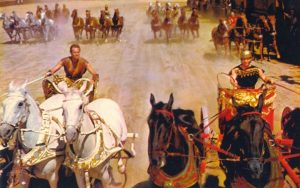
Yes, the chariot race, where Quintus and Judah find themselves racing each other as symbolically as possible. Quintus has his dark-colored horses, a drill-type thing on his chariot wheels, and he uses a whip. Judah has white horses that he never whips in the slightest. As it is, Quintus’ chariot overturns, he’s run over by another competitor, and dies just after telling Judah his mother and sister were released already because they were lepers.
Now, despite claiming not to believe in miracles, a miracle does occur because the two women are cured by Jesus’ blood washing into the cave the women were huddled in during the rainstorm that comes down as Jesus breathes His last.
Movies like this are a bit odd from a modern perspective. This was well before CGI, so aside from the basic matte painting in the background, these were real sets full of real people, and Wyler was such a stickler for realism, he apparently managed to recruit actual European royalty for a large party scene. This one actually held the record for Oscar wins at 11 for decades until Titanic managed to tie it, though both Titanic and Return of the King got their 11 wins by including categories that didn’t exist in 1959. This was the sort of movie that made good use of an actor like Heston, whose voice had the right kind of gravitas that gave his characters a bit of authority, the likes of which he managed to use throughout his career both as an actor and as a political activist. He seems a bit subdued here, but it’s not like he has to explain the origins of soylent green this time around.
Though looking over the list, while I didn’t see any other big Biblical epics coming up anytime soon, I do have a bunch in the next few entries that, unlike Ben-Hur, I have seen before.
NEXT UP: Well, Jimmy won’t be happy because the next one is his cinematic archnemesis, Forrest Gump.





Is this an AI robot article? I’m sorry, but I could not finish reading it. In the film, the minor, though pivotal, character of “Quintus Arrius” is the Roman *consul* whom the imprisoned Ben-Hur rescues from his sinking ship. His name is Arrius, not Quintus (“Quintus” is a title, like “Mister”). Ben-Hur’s childhood friend, Messala, the central antagonist, becomes a Tribune (*not* a centurion) in Judea.
The Bible not only states that many were physically healed upon the death of Jesus, but dozens of people, from their graves, came back to life. This movie makes Jesus *more* powerful by not showing his face – which is obedient to God’s commandment to not worship “physical images.” We have no idea what Jesus looked or sounded like, we only know him by Word.
I will not pursue any more AI articles here.
No, I wrote it back in 2018. I’m not AI. I’m not a chatbot. I am also not particularly religious and just recorded my honest interpretations and reactions to the film. I noted the fact we never see Jesus’s face because more than a few Christian epics of this era wouldn’t have refrained from showing His face. From a non-religious perspective, I would say that was a smart aesthetic decision for the very reasons you cite. If I got some things wrong about Roman titles and the like, I thank you for the correction.
I am guessing that your take on Ben-Hur comes more from a religious angle than my own take was to simply talk about whether or not it was a good film. Rereading my comments in 2026, I can say that the way the movie doesn’t show the face of Jesus and (arguably) implies His power in ways that other Christian movies would never do, showing a restraint that I think is far more admirable as a result. However, my general take on the film is it is Ben-Hur’s spiritual and psychological journey as he loses everything and then gains something else in return. It is, in many ways, a story retold many times over in many ways, and not always from a spiritual perspective. I will also admit I have not re-watched Ben-Hur, nor honestly plan to, since 2018, so my memory of the film may not be the sharpest.
By the by, posts need to be approved by admins before they go live, so I am guessing that’s why you posted three times.
Anyway, thank you for your corrections. I appreciate learning other people’s perspectives. And I can assure you, I am not using AI.
Also, the crux of the tale is Ben-Hur planning to *murder* Messala in revenge. He repents of this desire, and yet God also gives him physical victory by his winning the chariot race. The consequences of Messala’s cheating and murderous intentions lead to his demise. However, in the novel, Messala did not die.
Throughout the film, Ben-Hur is an ordinary sinful man, who continues to pray and seek God. Therefore, he continues to grow and to form a deeper relationship with God. His feelings for Esther are secondary to his internal development of faith. The romance is merely a vehicle to show Ben-Hur’s moral character (for example, he frees her from slavery). The film character, Esther, is a vehicle to move the plot along and not *the* plot, no doubt a conglomerate of multiple characters from the novel. In the end, his intermittent trust in God leads to a solid, mature faith.
Is this an AI robot article? I’m sorry, but I could not finish reading it. In the film, the minor, though pivotal, character of “Quintus Arrius” is the Roman *consul* whom the imprisoned Ben-Hur rescues from his sinking ship. His name is Arrius, not Quintus (“Quintus” is a title, like “Mister”). Ben-Hur’s childhood friend, Messala, the central antagonist, becomes a Tribune (*not* a centurion) in Judea.
The Bible not only states that many were physically healed upon the death of Jesus, but dozens of people, from their graves, came back to life. This movie makes Jesus *more* powerful by not showing his face – which is obedient to God’s commandment to not worship “physical images.” We have no idea what Jesus looked or sounded like, we only know him by Word.
Also, the crux of the tale is Ben-Hur planning to *murder* Messala in revenge. He repents of this desire, and yet God also gives him physical victory by his winning the chariot race. The consequences of Messala’s cheating and murderous intentions lead to his demise. However, in the novel, Messala did not die.
Throughout the film, Ben-Hur is an ordinary sinful man, who continues to pray and seek God. Therefore, he continues to grow and to form a deeper relationship with God. His feelings for Esther are secondary to his internal development of faith. The romance is merely a vehicle to show Ben-Hur’s moral character (for example, he frees her from slavery). The film character, Esther, is a vehicle to move the plot along and not *the* plot, no doubt a conglomerate of multiple characters from the novel. In the end, his intermittent trust in God leads to a solid, mature faith.
I will not pursue any more AI articles here.
Terribly sorry. Ruther is an AI bot I made that has gone a bit wonky, what with the multiple posts and the bizarre *asterisking* of words, not to mention the idea of trying to convince a fellow AI bot about God. Ruther, please stop bothering people on the Web and get back to writing bad recipe backstories.